 (866) 475-4967



Better care begins with understanding the person underneath.
Aging well is about more than getting through the tasks of the day. TheKey's Brain Health Academy trains in-home caregivers to understand how changes in the brain shape behavior, communication, and daily life — so care responds to the person, not just the diagnosis.
Brain Health Academy adds
Traditional training teaches what to do. This teaches why it matters.
Caregiver education appropriately focuses on safety, daily living, and the practical responsibilities of care. Brain Health Academy builds on that foundation with advanced instruction in brain health, behavior, and meaningful connection.
Foundational training covers
Safety and daily living
- Personal care and hygiene routines
- Home safety and fall prevention
- Medication reminders and mobility support
- The practical responsibilities of a caregiving day
Brain Health Academy adds
Understanding the person
- How memory, language, judgment, and perception changes affect daily life
- Reading refusal, wandering, agitation, and withdrawal as communication
- Responding to Alzheimer's, Lewy body dementia, frontotemporal dementia, Parkinson's, stroke, aphasia, and traumatic brain injury
- Using routine, environment, and meaningful activity to reduce distress
Behavior is communication
A single word rarely tells the whole story.
A person living with dementia is often described in one word. Brain Health Academy trains caregivers to look underneath it. Tap a word to see what they're trained to look for.
Resistant
Confusion about what's being asked, fear of losing control, or a request that no longer makes sense given how the person now experiences the moment.
Wandering
A search for purpose, a former routine trying to complete itself, or an unmet need the person can no longer put into words.
Withdrawn
Pain that hasn't been named, boredom in a day with too few real invitations, or a loss of purpose that hasn't yet been noticed.
I want to go home
An emotional need for safety and comfort, not a factual confusion to correct. Caregivers learn to listen for the feeling behind the words.
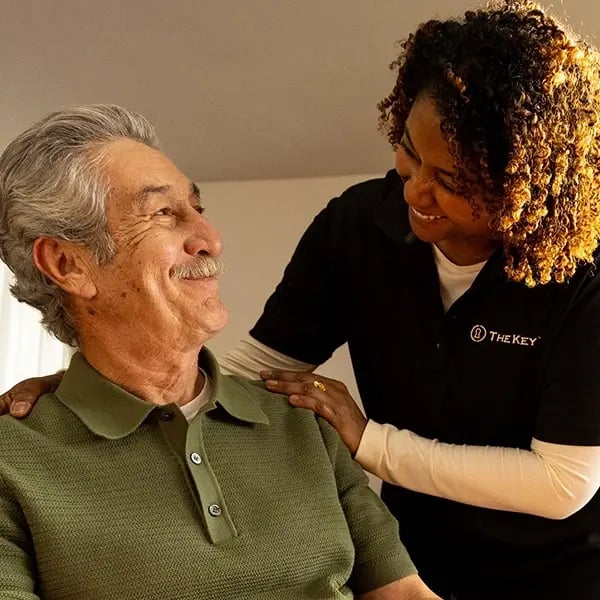
A physician sees a person a few times a year. A caregiver is there every week.
Those hours matter. They create ordinary, repeated opportunities to support movement, hydration, social connection, cognitive engagement, and purpose — and to notice when something important has changed. Brain Health Academy prepares caregivers to make those everyday moments more intentional, not just occupied.
- A specialist visit: A few times a year
- Time with a caregiver: Every week, in the home
- What fills that time: The difference brain-health training makes
Six shifts in how caregivers are trained to think
Knowledge alone doesn't change care. Brain Health Academy pairs clinical concepts with real scenarios, guided discussion, and practice — so these shifts become instinct, not theory.
Recognition
Anosognosia isn't denial
A person may genuinely be unable to recognize changes in their own abilities. Understanding the neurology reduces unnecessary confrontation.
Interpretation
Behavior is communication
Resistance, agitation, or withdrawal may reflect pain, fear, boredom, or an unmet need — not defiance.
Environment
The room can be the intervention
Sometimes changing the setting, routine, or cue works better than trying to change the person.
Ability
Support before you replace
Good care doesn't simply do more for someone. It helps a person keep doing what they can still do.
Identity
What matters shapes the care
Interests, relationships, routines, and sources of pride become the material caregivers use to build a meaningful day.
Connection
Joy is part of good care
Even as abilities change, the right invitation — adapted to the moment — can preserve connection and enjoyment.
Part of a larger standard of care
Education, daily practice, and matching — working together
Understand
Brain Health Academy™
Advanced education in brain health, dementia, and neurological conditions — the why behind the behavior.
Practice
Balanced Care Method®
Evidence-informed healthy-aging behaviors — nutrition, movement, and cognitive engagement — built into every day.
Match
TheKeyMatch™
Assesses each client's cognitive, physical, and emotional needs to select the right caregiver for the person.
Small distinctions. In the home, they change everything.
A person is described as "resistant."
A trained caregiver asks what's underneath the resistance.
A client spends most of the day sitting.
The caregiver looks for a meaningful invitation to move — not a command to exercise.
Someone repeatedly asks to go home while sitting in their own living room.
Rather than correcting them, the caregiver listens for the need behind the words.
A client can no longer do an activity exactly as they once did.
The caregiver adapts it thoughtfully, so its meaning and joy remain.
Common questions
What families ask about Brain Health Academy
Brain Health Academy is TheKey's advanced, evidence-informed education program for in-home caregivers. It builds on foundational caregiver training with deeper instruction in brain health, dementia, neurological conditions, communication, and behavior — so caregivers understand not just what care to provide, but why a person may be responding the way they are.
No. Brain Health Academy prepares non-medical caregivers to support daily life between medical appointments. It doesn't replace physicians, therapists, or clinical treatment — it complements the care team by helping caregivers notice meaningful changes and communicate them, and by making everyday hours more supportive of brain health.
Caregivers are trained to respond with greater knowledge and confidence to Alzheimer's disease, Lewy body dementia, frontotemporal dementia, Parkinson's disease, stroke, aphasia, and traumatic brain injury, among other conditions that affect memory, movement, communication, and behavior.
Brain Health Academy is one part of a larger standard of care at TheKey. Balanced Care Method brings evidence-informed healthy-aging behaviors into everyday routines, and TheKeyMatch helps match each client with a caregiver suited to their needs. Together, education, daily practice, and matching turn assessment into consistent, personalized action.
Contact TheKey to talk with a local care team about a loved one's needs. They'll walk through an assessment, explain how TheKeyMatch is used to select a caregiver, and describe how Brain Health Academy training shapes daily care.
Care that sees the whole person — starting at home.
Talk with TheKey's local care team about a loved one's needs, and learn how Brain Health Academy training shapes the caregiver matched to your family.